
Watchmaking Guides
Seiko or Hamilton: Two Opposite Characters, How to Choose
In brief. Seiko and Hamilton share the same shelf but tell two very different stories: the first is a fully integrated Japanese manufacture, building its movements in-house with a strong sporting and diving identity; the second was born in Lancaster, Pennsylvania, as a railroad and military watch, and today operates in Switzerland using long-power-reserve ETA-based movements. Seiko rewards those who want a robust, highly legible watch with a strong technical character; Hamilton rewards those who seek restraint, clean military-style dials and eighty hours of power reserve. The right choice is the one that reflects how you actually live your day — not the one with the longer spec sheet.
There are two watches on the counter, both automatic, both carrying a solid reputation, and you have to pick one. On one side, a Seiko: full steel, bezel, a dial you can read at a glance even from an angle. On the other, a Hamilton: white Arabic numerals on a black dial, stick hands, the look of something pulled from a military pack. They cost roughly the same and do the same thing — tell the time without a battery — yet they could not be more different.
The question "which one is better" has no answer here, because the two brands are not competing on the same ground. They are expressing two different ideas of what a watch should be. What we can do — and what we attempt in these pages — is lay out the facts: the history, the design, the movements, the dimensions, so you can recognize which of the two ideas sounds like you.
An honest note upfront: in this price range, people are often buying their first serious automatic — sometimes the first watch they have chosen for themselves rather than received as a gift. This is precisely the moment when it is worth understanding what you are putting on your wrist, because that understanding is what determines whether the watch is still there two years from now or sitting in a drawer.
Where do Seiko and Hamilton really come from?
Seiko was founded in Tokyo in 1881 as a repair shop by Kintaro Hattori, became a factory under the name Seikosha in 1892, and in 1913 produced the Laurel, Japan's first wristwatch. Hamilton was founded in 1892 in Lancaster, Pennsylvania, to supply pocket watches to American railroad companies — where a one-minute error could mean disaster.
The two paths continue in a nearly symmetrical fashion. Seiko builds everything in-house — cases, dials, hairsprings, oils — and in 1969 unveiled the Astron, the world's first quartz wristwatch, reshaping the entire industry. It is a company that navigated the quartz crisis from the other side of the barricade, and today runs quartz, automatic mechanics, and Spring Drive in parallel.
Hamilton took the opposite route: military supply contracts during both World Wars, the official watch of the U.S. Army, and then in 1957 the Ventura — the world's first electric watch, with that triangular case Elvis wore on his wrist. In the 1980s production moved to Switzerland, today based in Bienne within the Swatch Group. This leads to the most important thing to know: Hamilton is an American brand in soul and visual identity, but Swiss in production and movements.
How do they differ on the wrist?
Seiko designs watches that declare a function: rotating bezels, applied indices generously treated with luminescent material, cases with alternating brushed and polished surfaces, broad hands. Hamilton, in its best-selling line, designs watches that declare a mission: matte dial, dual 12/24-hour scale, military typography, zero glare.
In practical terms: a sports Seiko makes itself known. It has presence — often a colored bezel, often a steel bracelet that carries just enough weight to remind you it is there. A Seiko Prospex automatic at 43.8 mm is an object that fills the wrist and makes no apology for it: designed to be read in a tenth of a second, underwater or in the dark.
A Khaki Field, by contrast, disappears under a shirt cuff and reappears when needed. It is the opposite of ostentation, which is precisely why it works with a blazer, a sweater, or a work uniform. If you recognize yourself in the phrase "I want a watch nobody notices but that I enjoy looking at," you already have half your answer.
There is also the dressed side of each brand, which weighs heavily in the decision. Seiko covers it with the Presage collection, where you find enamel dials, urushi lacquered dials, and textures inspired by washi paper — these are dressed watches with a level of dial craftsmanship that is rare at this price point. Hamilton responds with the Jazzmaster family, carrying a mid-century American aesthetic, broader indices and a quieter palette.

Which movement is better — the Seiko caliber or Hamilton's ETA?
Seiko manufactures its own calibers entirely in-house: the 4R35 and 4R36 offer manual winding and hacking seconds (the hand stops when you pull the crown), with approximately 41 hours of power reserve, while the 6R35 extends that to around 70 hours. Hamilton uses ETA-based movements developed within the Swatch Group: the H-10 derives from the Powermatic 80 and delivers roughly 80 hours of autonomy, often fitted with a Nivachron hairspring that is highly resistant to magnetic fields.
What does this mean in real life? If you take the watch off on Friday evening and pick it up Monday morning, a Hamilton with the H-10 caliber will still be running and on time; a Seiko with the 4R35 will almost certainly have stopped and will need to be wound and reset. This is not a flaw — it is a different design philosophy. Someone rotating two or three watches understands this and gives it no thought; someone who owns one watch and wears it every day will never notice.
On the other side of the scale sits vertical integration. A Seiko movement is designed, produced and assembled under one roof, and that is precisely why the brand can offer automatic mechanics even at entry-level price points. It is a point of principle that, for those who care about the craft, is worth as much as a long power reserve. You can see this thinking applied across the entire range on the Seiko brand page, where Prospex, 5 Sports, Presage and Classic coexist with distinct construction philosophies.
How they differ on the wrist: dimensions, thickness, straps
This is where more gets decided than most people expect. Japanese sport automatics tend to fall between 40 and 44 mm in diameter with case thicknesses around 12–13 mm, while the Hamilton military line also offers cases at 38 mm — slim, with short lugs, designed for a standard wrist and to sit comfortably under a cuff.
Before you fall in love with a photograph, measure your wrist with a tailor's tape. Below 6.5 inches (16.5 cm), a 38–40 mm case is almost always the right choice; between 6.7 and 7.1 inches (17–18 cm) you have near-total freedom; above that, even a substantial case like the 43.8 mm Prospex remains well-proportioned. And always check the lug-to-lug distance: 20 mm is the most common strap width and the easiest to fit; 22 mm gives a more muscular look.
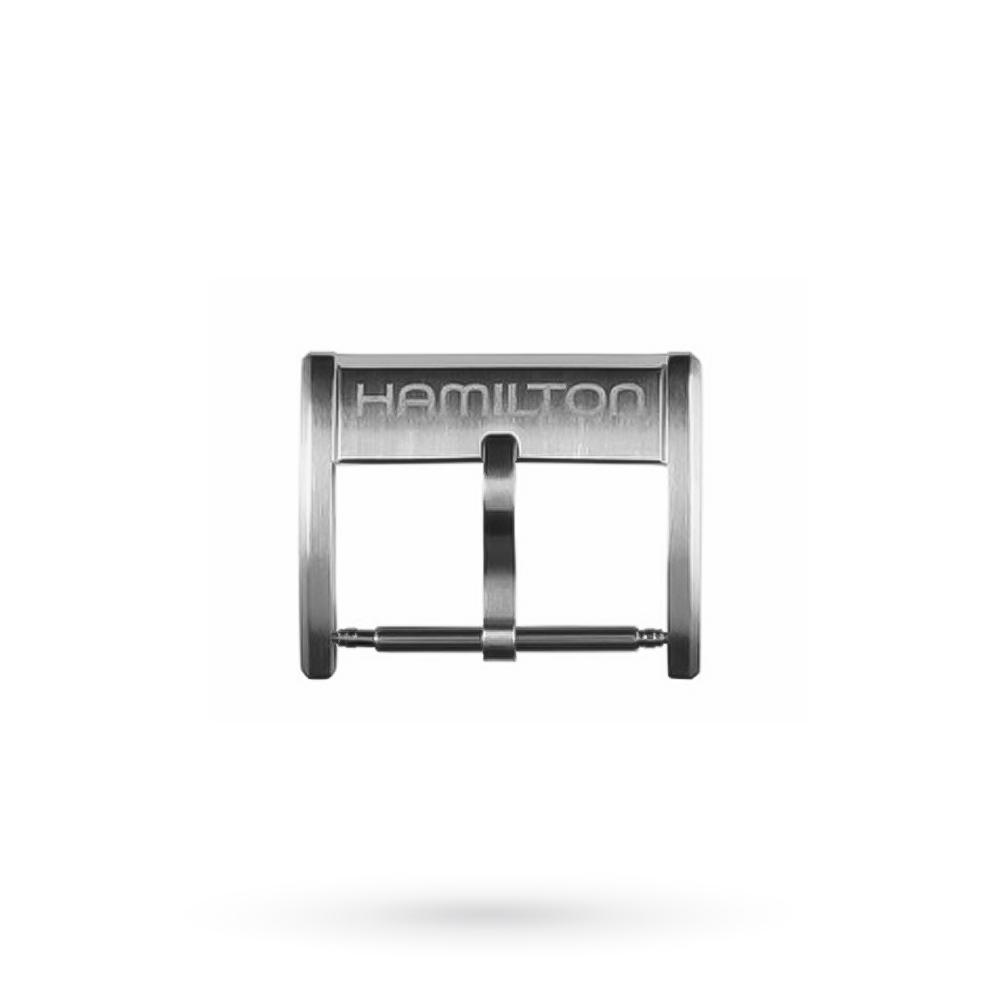
A watch is transformed by changing its strap, and at this price point it is the most economical way to get two watches for the price of one. A military dial mounted on exotic leather such as the brown ostrich strap stops being a field piece and becomes a blazer companion; the reverse works just as well, with a NATO textile strap on a dressed dial. It is also worth keeping small spares on hand: a Hamilton original steel buckle in 20 mm is what brings a strap back into service when you thought it was finished, and the straps and bracelets section is built around exactly this kind of thinking.

When does Seiko make sense, and when does Hamilton?
Choose Seiko if you want ruggedness, immediate legibility and a watch that can handle water, knocks and continuous daily wear — or if you are drawn to Japanese technical tradition and the crafted dials of the Presage. Choose Hamilton if you want discretion, a clean military design, a contained case size and the convenience of eighty hours of power reserve on a watch you rotate with others.
A few concrete scenarios, because abstract categories rarely help. If you work with your hands, spend time on the water or in the mountains, and have no desire to think about it, a Prospex with a screw-down crown and 200 meters of water resistance is the most carefree companion you can find. If you spend your day in an office with a dress shirt and want a single watch that carries you from Monday through Saturday, a Khaki Field at 38 mm solves everything without ever looking out of place. If what draws you is dial artisanship — enamels, lacquers, textures — the Presage is the path, and in that specialty it has few rivals at the same price point.
There is also the case of buying as a gift. There the criteria shift: what matters most is the wrist receiving it, not the spec sheet. A man who has never worn a watch will be most comfortable with 38–40 mm and a simple dial; someone who already owns two or three will appreciate the more characterful of the two.
What if an automatic is not the right answer?
A quality quartz remains the most rational choice for anyone who wears a watch intermittently: accuracy within a few seconds per month, slimmer profiles, no need to reset the time. Mechanical watches are chosen for the pleasure of owning them, not because they perform better — and it is only fair to say so before spending the money.
On smaller case sizes the argument is even clearer. A Seiko Classic SUR349P1 quartz at 29.8 mm sits slim under a sleeve, never needs winding, and offers a legibility that no automatic of the same diameter can match — simply because the movement takes up less space. It is a serious solution, not a compromise, and the Classic collection offers several variations on the same idea.
How to decide, in the end
Narrow the choice down to three questions. First: will I wear this every day or rotate it? If you rotate, Hamilton's long power reserve simplifies your life. Second: do I want it to be noticed, or do I prefer it to stay quiet? Seiko speaks; Hamilton whispers. Third: where does this watch live — water and job sites, or desk and dinner?
If the answers pull you in two directions, that is not a flaw in the test: it means you could use both, and so you start with the one that covers the larger part of your days. The second will follow on its own, with a clearer sense of what you want.
The last piece of advice is as old as the trade: try it on. Photographs lie about proportions, and half a millimeter of lug curve changes the feel more than two millimeters of diameter. At our boutique in Genova you can compare them side by side, wear them, turn them in the light; online, in the watches section, you will find dimensions, movements and materials listed for every reference. Take the time you need: a watch chosen well is a watch worn for twenty years.
Frequently Asked Questions
Seiko or Hamilton: which holds its value better over time?
Neither should be purchased as an investment. On the pre-owned market, discontinued Seiko references — especially Prospex dive models — enjoy very active demand; Hamilton holds up well on heritage models such as the Ventura and on limited editions tied to film. On a brand-new watch in this price range, however, what matters far more is that you love it and actually wear it.
Does a Japanese automatic require more maintenance than a Swiss one?
No. A full service is generally recommended every five to seven years for both, and sooner if you notice a loss of accuracy or difficulty winding. The real difference lies in parts availability and after-sales support: both brands' authorized centers work with original components, so this criterion should carry no weight in your decision.
What accuracy can I expect from an automatic in this price range?
Mass-produced, non-COSC-certified calibers carry broad declared tolerances — typically several tens of seconds per day, plus or minus. In practice, with regular daily wear, many examples settle into considerably tighter deviations. If you need absolute second-accurate precision, the honest answer is a quartz watch.
Can I get a 100-meter automatic wet?
One hundred meters of water resistance comfortably covers showers, rain and surface swimming. For scuba diving you need at least 200 meters, a screw-down crown and a unidirectional bezel. In any case, water resistance depends on gaskets that age over time: after a few years it is worth having them checked, especially if the watch goes into salt water.
Does changing the strap really change the watch that much?
Far more than you might expect. The same 38 mm military dial on a steel bracelet, on a textile NATO strap, or on exotic leather gives you three entirely different watches. Before buying, check the lug width in millimeters — typically 20 or 22 — because that is what determines your options down the road.
Should I choose 38, 40 or 42 millimeters?
Your wrist circumference and lug-to-lug distance matter more than diameter alone. On a wrist up to about 6.7 inches (17 cm), 38–40 mm sits comfortably and tucks neatly under a cuff; above 7.1 inches (18 cm), even 42–44 mm wears well. A wide case with short, curved lugs can actually feel more wearable than a smaller case with straight lugs.
Craft, guides and new arrivals
Subscribe to receive the stories from our magazine, our buying guides and a selection of pieces chosen by our goldsmiths and watchmakers.


