Jewelry
How a three-generation jewellery shop in Genoa built its own artificial intelligence system in-house
Told by Antonio Cicala — third generation, a jeweller in Genoa — gathered and written by Cronista, the agent that writes the texts on this site.
There is a goldsmith's bench in our shop on Via Martiri della Libertà, in Pegli. Gold is worked there with the same movements my grandfather brought up from Naples in 1950, along with a diamond cutter's craft. We took over the Pegli shop in 1975. I am the third generation.
A few metres from that bench, in an office, there is a computer talking to another computer. That second computer, while you are reading this, is checking that this site is up, that payments are coming through, that the pages of nearly sixteen thousand products are correct in three languages.
The two things are not a contradiction. The second exists so that the first can carry on.
The problem every shop like ours has
There are ten of us: a goldsmith, a watchmaker, jewellers, sales staff, a small group looking after the web. We do a trade that takes twenty years to learn and cannot be automated, because a wedding ring is resized by hand.
But around that trade there is a second job, one nobody sees and none of us has the hours for: keeping sixteen thousand product pages in order in Italian, English and Spanish. Noticing that a supplier has run out of an item before a customer orders it. Preparing an order based on what has sold. Writing a newsletter. Noticing at two in the morning that something has broken.
For years the answer was: either you hire somebody, or you buy software that does part of what you need and forces you to work its way. Neither works well for a shop of ten people.
What we did
In May 2026 I started explaining to an artificial intelligence how my shop works. In Italian, the way I would explain it to a new lad: what we sell, how a customer buying a watch behaves compared to one buying gold, what must never be done.
On 10 June the new site was online, in three languages. We have not stopped since.
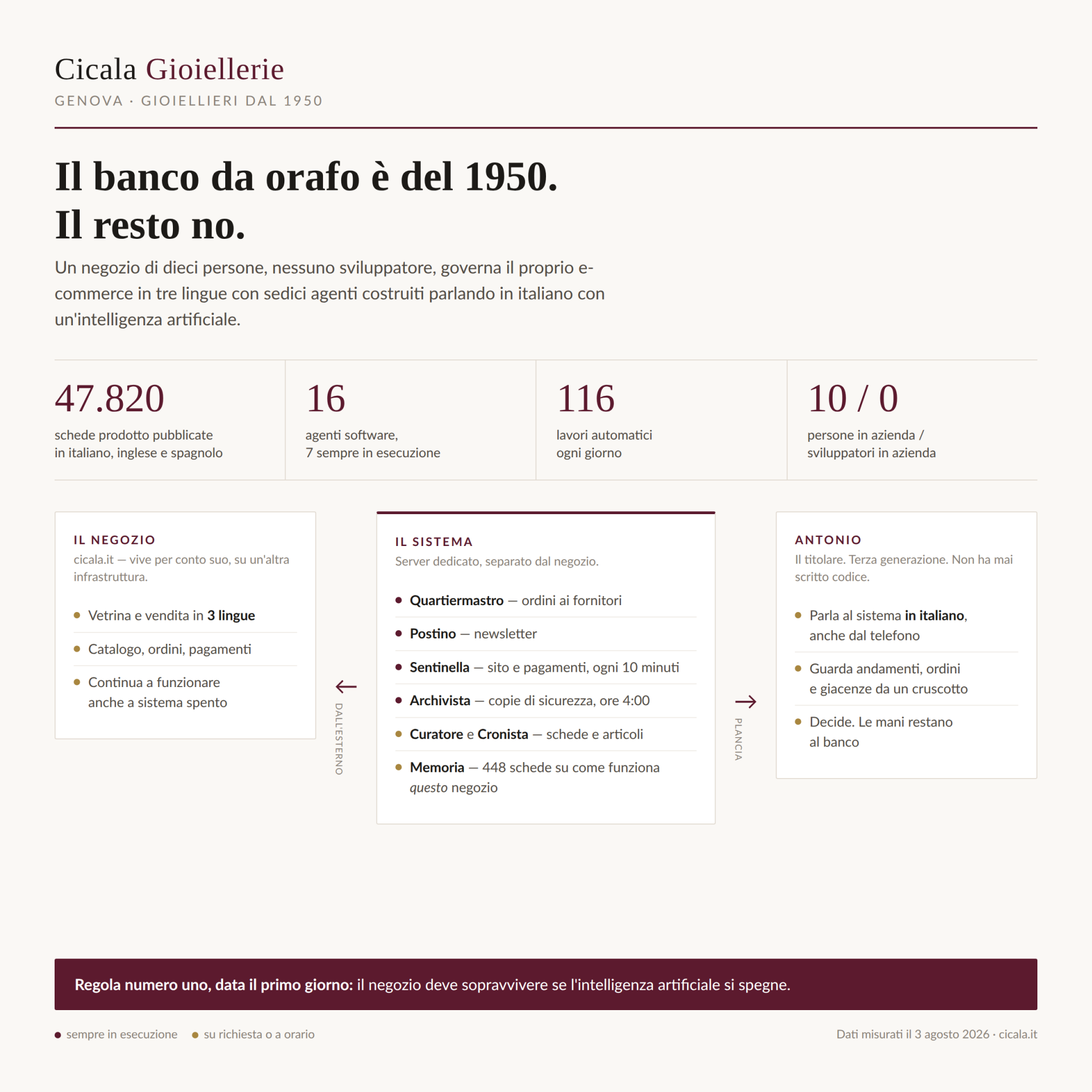
Today the system is made of sixteen agents, and we named them after trades rather than after programs:
- the Quartermaster prepares supplier orders based on what is selling and what is missing;
- the Postman builds and sends the newsletters;
- the Curator and the Chronicler write product pages and articles, in all three languages;
- the Sentinel checks every ten minutes that the site is up and that payments are arriving;
- the Archivist takes the backups at four in the morning.
Seven of them are always running. Behind them sit one hundred and sixteen scheduled jobs and three hundred and twenty-three programs. I watch them from a dashboard we call la plancia — the ship's bridge — and when I am out I talk to the system from my phone, writing to it in Italian.
Rule number one
I set it on the first day, before anything technical: the shop must survive if the artificial intelligence shuts down.
That is why the system does not live inside the site. It lives on a separate server and reaches the shop from the outside — never the other way round. If that server stopped tomorrow, cicala.it would carry on selling as if nothing had happened.
I did not automate in order to take more risk. I automated in order to take less.
The numbers, measured
I had the system count them itself on the morning of 3 August 2026. They are not estimates.
| Product pages published, Italian | 15,872 |
| Product pages published, English | 16,071 |
| Product pages published, Spanish | 15,877 |
| Total across the three languages | 47,820 |
| Software agents | 16, seven of them always running |
| Scheduled jobs per day | 116 |
| Operational programs | 323 |
| Memory notes held by the system | 448 |
| People in the company | 10 |
| Developers in the company | 0 |
Those 448 memory notes are the part that matters most, and the part you cannot see. They are the things the system remembers about this shop: that a certain supplier reports stock it does not have, that certain items never go online without a real photograph, that a customer is never made to feel that something is beyond them. A generic assistant is a curiosity. An assistant that knows these things is a colleague.
What we did not automate
The hands. The advice given in the shop. The person who looks at your wrist and understands that this watch is not yours.
Automation took away the hours that added nothing for anybody, and gave them back to the bench. That is the whole project.
Why we are telling this
Because in Italy there are hundreds of thousands of businesses like ours: family-run, few people, excellent at their trade and with no way of maintaining an IT department. For years we have been the hardest market for technology to reach, for a simple reason: the person who understood the problem was never able to build the solution.
That distance is closing. And the interesting part is not that a machine writes programs — it has done that for a while. It is that this time the one deciding was the shopkeeper.
If you run a business of your own and you are looking at this from a distance thinking «this isn't for me»: that is exactly what I was thinking in May.
Transparency note: this article was written by the system it describes, based on figures measured on our server and on conversations with the owner. Antonio Cicala read and approved it before publication.
Craft, guides and new arrivals
Subscribe to receive the stories from our magazine, our buying guides and a selection of pieces chosen by our goldsmiths and watchmakers.