Watchmaking Guides
Best Mid-Range Men’s Watches: The Honest 2026 Guide
In brief. In the mid-range, there is no single best brand: there is the one that matches how you live and what you expect from your watch ten years from now. Seiko and Squale reward robustness and character, Tissot and Mido offer Swiss reliability at a reasonable price, Hamilton brings style rooted in military heritage, Longines delivers finishing and prestige. At equal specs, the real difference lies in the movement fitted, the quality of the bracelet, and the realistic possibility of having the watch serviced over time.
The question almost always comes in the same form: "I have a budget — which brand is truly worth my money?" It's a fair question, and it has no single answer, because in this segment brands don't compete on spec sheets — those look quite similar — but on something harder to measure: the kind of watch they have in mind, the care taken with finishing where no one looks, and how easy it will be to have the watch repaired eight years from now.
The risk, when you compare five brands in a table, is picking the one with the highest number in some random column, only to realize six months later that the watch simply isn't yours. It happens often with case diameters, it happens with power reserves, it happens with water resistance figures in meters that no one will ever use. A watch worn every day is a creature of habit: either it fits into your life or it stays in the drawer.
Below you'll find profiles of the brands most commonly encountered in this segment, described for what they are and for whom they make sense. No ranking: five different paths, and at the end a few criteria to help you figure out which one is yours.
Which watch brand truly delivers value in the mid-range?
There is no single best brand: in the mid-range, value is measured on three concrete things — the movement fitted in that specific reference, the quality of the bracelet and case, and the existence of accessible after-sales service over time. At the same price point, two watches can differ enormously on exactly these points, and almost no one highlights this clearly.
The second criterion, less technical but equally decisive, is coherence. The brands that endure in the minds of those who buy them have a precise idea of what a watch should be: Seiko thinks about robustness, Longines about dial finishing, Squale about the sea. When that idea aligns with yours, the watch ages well. When it doesn't, even the most celebrated reference becomes something you dislike without quite knowing why.
One piece of advice that applies across all brands: look at the case finishing from the side, not straight on. That's where you see the difference between careful machining and a rushed shell — and that's what your eyes will see every day when you check the time.
Is Seiko still worth it, or is it just habit?
Seiko remains the reference for anyone who wants a mechanical watch that asks nothing of them, and the reason is industrial: the Japanese house produces its movements, cases, dials and hairsprings in-house, which allows it to place mid-range specifications that would cost more elsewhere. The Seiko Prospex line is where the ratio between technical content and price is most evident.
The Seiko Prospex SPB143J1 is the example I use most often when someone wants to understand what changes as you step up: 40.5 mm case, sapphire crystal, 200 meters water resistance and automatic caliber 6R35 with a 70-hour power reserve. In plain terms: take it off Friday evening and it's still running Monday morning. Its character is that of a vintage diver rethought, with short lugs that make it sit on the wrist better than the diameter alone suggests.
If instead you need a watch for work, travel and zero fuss, a Seiko quartz does something a mechanical simply doesn't: accuracy within a few seconds per month and no maintenance beyond the battery. A Seiko Classic SUR307P1 at 40.2 mm is the classic second watch that ends up becoming the first, because it's slim, fits under a cuff and asks for nothing.
Who it's made for: those who want technical substance and don't need the watch to make introductions on their behalf.

Tissot and Mido: what's the real difference between the two?
Tissot and Mido belong to the same group and share the same base of automatic movements with an 80-hour power reserve, so the difference lies not in the mechanics but in aesthetic language and range. Tissot is broader and more versatile: it covers sport, dress, chronograph and quartz with a range of references large enough to make it almost certain you'll find your own. It is the quintessential entry-level Swiss brand, and for good reason: it gets very few things wrong.
Mido works within a narrower, more distinctive idea. Each collection is explicitly inspired by a building or structure, and you feel it in the proportions: clean dials, geometric indices, cases that look as though they were drawn with a set square. The Mido Commander Icone at 42 mm is the clearest example, with its lug-free case and bracelet that flows directly from the case body: on the wrist it sits and settles differently from anything else in this segment. Those seeking a more formal look will find in the Belluna line sober 41.30 mm dials that pair beautifully with a jacket without looking overdressed.
Who they're made for: Tissot for those who want to choose from many paths with the assurance of Swiss Made; Mido for those who already know they love one particular form and want it done right.
Does Hamilton make sense if I want something with real character?
Hamilton is the right brand if you care about your watch telling a story: born in Lancaster, Pennsylvania, and now manufactured in Switzerland, it built its identity on military and aviation watches and has never diluted it. The Khaki Field models are the most direct translation of that heritage: black or beige dials with Arabic numerals, instantly readable hands, compact cases designed to be read in a second.
Hamilton's strength in this segment is that its watches remain properly sized. Many references fall between 38 and 42 mm and maintain a low profile, making them wearable even under a dress shirt. It's also a brand that lends itself to personalization: changing the strap radically changes the character of the piece, and a Hamilton American Classic Ardmore 18-16 mm strap with EasyClick attachment fits in seconds without tools, which actually encourages you to do it.
Who it's made for: those who want a watch with a recognizable story and prefer understatement to display.

Is Longines already in a different league?
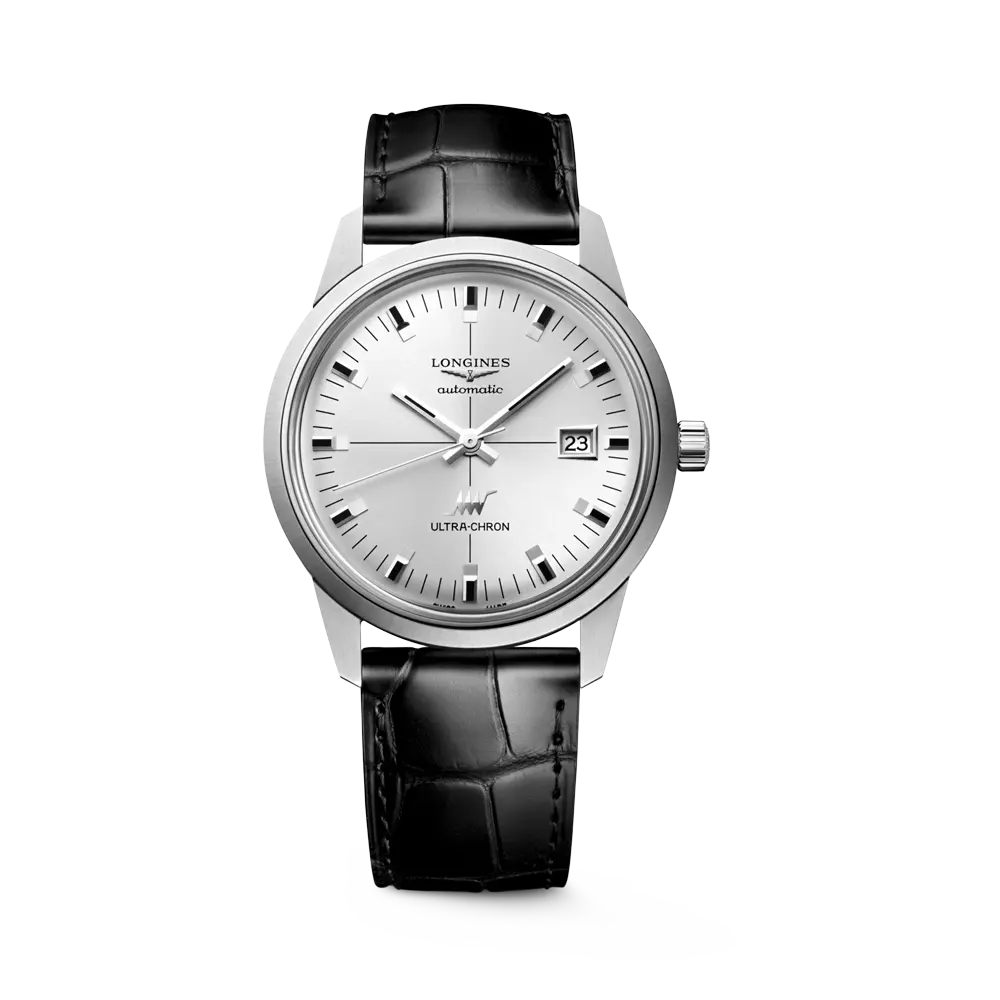
Yes, and the difference shows most clearly in dial finishing and bracelet craftsmanship — the two areas where mid-range watches most often cut corners. Longines was founded in Saint-Imier in 1832 and carries a serious sporting and chronometric legacy: certain lines feature exclusive movements with extended power reserves and chronometric certifications, and the positioning is felt in the overall impression rather than in any single specification.
There is another path worth considering, one I recommend to those with a taste for the classic: the pre-owned market. A Longines Flagship 350 in 18kt yellow gold at 35 mm — 750/1000 gold case, silver dial, automatic winding — offers a kind of elegance that today, in steel and new, is simply not found with the same naturalness. The 34–35 mm cases of the classic 1950s and 1960s pieces have become perfectly wearable once again, and those who try them rarely look back.
Who it's made for: those who place dial elegance above the spec sheet.
What if I want a real dive watch, not just an aesthetic reference?
Then the answer is Squale, a Swiss brand tied since the 1950s to the production of cases for professional diving watches. The 1521 is not a stylistic interpretation of the genre: it is a dive watch with 500 meters water resistance, a 42 mm case, unidirectional bezel and Swiss automatic movement.
The Squale 1521 Black Blasted features a sandblasted finish that neither reflects light nor ages badly — precisely because it was never polished to begin with: the marks it acquires become part of the object rather than damage to it. It is an undiplomatic and deeply coherent choice, for those who want a watch that pretends to be nothing it isn't.

How do I actually choose, in the end?
Narrow the field with three questions, in this order: how often will I wear it, what will I wear it with, how much does it bother me to wind or regulate a watch. If the answer to the third is "quite a lot," quartz is not a compromise but the right choice; if instead the idea of a mechanism that lives off your movement appeals to you, an automatic with a long power reserve is the path that brings the most satisfaction over time.
Then check two details that online comparisons almost always skip. The first is the lug-to-lug distance: it determines fit far more than the diameter, and a well-designed 42 mm can wear better than a poorly executed 39 mm. The second is the bracelet clasp: a micro-adjustment buckle is a genuine comfort in summer, when the wrist changes size throughout the day.
One last thing, the least romantic but the most useful: ask yourself where you'll take it in six years for a service. A well-chosen watch lives through many of those years, and the difference between a happy purchase and a regretted one almost always comes down to exactly that. If you'd like to try a few on the wrist, half an hour in our Genova boutique will tell you more than a week of online research.
Frequently Asked Questions
How often should an automatic watch be serviced?
As a general guideline, a full service is recommended every four to six years — sooner if the watch is frequently exposed to water or if you notice a significant drop in power reserve. Gasket and water-resistance checks, on the other hand, are worth doing every two years: they cost little and prevent serious damage, which is almost always moisture-related.
Does a mid-range watch hold its resale value well?
Generally, no — and it's not the right criterion for choosing one. Some highly sought-after references retain their value better than others, but a watch in this segment should be bought to be worn, not as an investment. If resale value weighs on your mind, it makes more sense to look at the pre-owned market, where someone else has already absorbed the initial depreciation.
Does a sapphire crystal really make a difference?
Yes, and it's one of the most tangible differences in daily use. Synthetic sapphire resists scratches far better than treated mineral glass: after five years of wear, the dial is still clearly legible through a clean crystal. If you're comparing two similar models and one has sapphire, that detail is worth more than an extra complication.
What case size should I choose?
What matters is the ratio between the diameter and the lug-to-lug distance, not the number alone. On a wrist of 6.3–6.7 inches (16–17 cm), cases between 36 and 40 mm work well; from 7 inches (18 cm) upward, 40–43 mm is perfectly manageable. A 42 mm with short, curved lugs can wear more comfortably than a 39 mm with long, straight ones: trying it on remains the only honest test.
Is it better to buy online or in a store?
It depends on how certain you already are. If you know the exact reference, buying online is convenient and the warranty is the same. If you're still deciding, trying three or four models on the wrist in half an hour clarifies more than twenty reviews: weight, lug curvature and dial legibility simply cannot be understood from a photograph.
Does changing the strap void the warranty?
No, provided the strap is compatible and the swap is done correctly. Many recent models feature quick-release attachments that allow a change in seconds without tools. The one caveat applies to dive watches: if you replace a steel bracelet, make sure the spring bars are of adequate gauge — that's where both security and water resistance are at stake.
Craft, guides and new arrivals
Subscribe to receive the stories from our magazine, our buying guides and a selection of pieces chosen by our goldsmiths and watchmakers.