Jewellery Guides
Ring Size Guide: How to Measure at Home Without Getting It Wrong
Ring size is one measurement — the inside circumference of the ring in millimetres — wearing three different national costumes. Italy calls a 54 mm ring a size 14 (the circumference minus forty). The United States calls it roughly a 6 ¾. Britain calls it an N ½. Get the millimetres right and every chart in the world will agree with you.
The reliable method: start from a ring that already fits
If you can borrow a ring the person already wears on that finger, you are almost done. Lay it flat and measure the inside diameter — inner edge to inner edge, straight through the centre — with a real ruler. Then read it off the table below.
Two things decide whether this works. Measure the inside, not the outside: on a 4 mm wide band the difference is more than two sizes. And use a physical ruler, not a phone screen or a printed template — printers rescale pages far more often than people realise, and a template printed at 96% is a template that lies.
| Inside circumference | Inside diameter | Italy | US | UK |
|---|---|---|---|---|
| 47 mm | 15,0 mm | 7 | 4 ¼ | H ½ |
| 49 mm | 15,6 mm | 9 | 4 ¾ | J ½ |
| 51 mm | 16,2 mm | 11 | 5 ¾ | L |
| 53 mm | 16,9 mm | 13 | 6 ¼ | M ½ |
| 55 mm | 17,5 mm | 15 | 7 | O |
| 57 mm | 18,1 mm | 17 | 8 | P ½ |
| 59 mm | 18,8 mm | 19 | 8 ¾ | R |
| 61 mm | 19,4 mm | 21 | 9 ½ | S ½ |
| 63 mm | 20,1 mm | 23 | 10 ½ | U |
| 65 mm | 20,7 mm | 25 | 11 ¼ | V ½ |
The paper-strip method
With no ring to copy, measure the finger. Cut a strip of paper about half a centimetre wide — paper, not string or wool, which stretches and will cost you two sizes. Wrap it around the base of the finger, snug but not tight, mark where it overlaps, open it out and read the length in millimetres. That is the circumference.
Then check the knuckle. If the knuckle is clearly wider than the base of the finger, the right size is not the base measurement: it is the size that passes over the knuckle and still sits reasonably still below it. Measure both, take something in between, and lean towards the larger number. A ring that will not go on is a ring nobody wears; a slightly loose one can be taken in.
Four traps worth knowing about
- Time of day. Fingers swell in the afternoon and in the heat, and shrink in the cold and first thing in the morning. Measure mid-day, with warm hands, and never straight after exercise.
- Hands are not symmetrical. For most people the dominant hand runs about half a size larger. Measure the hand the ring will actually live on.
- Wide bands wear tighter. A 6-8 mm band grips more of the finger than a thin one, so it often needs half a size more. Worth remembering if you are choosing between wedding bands of different widths.
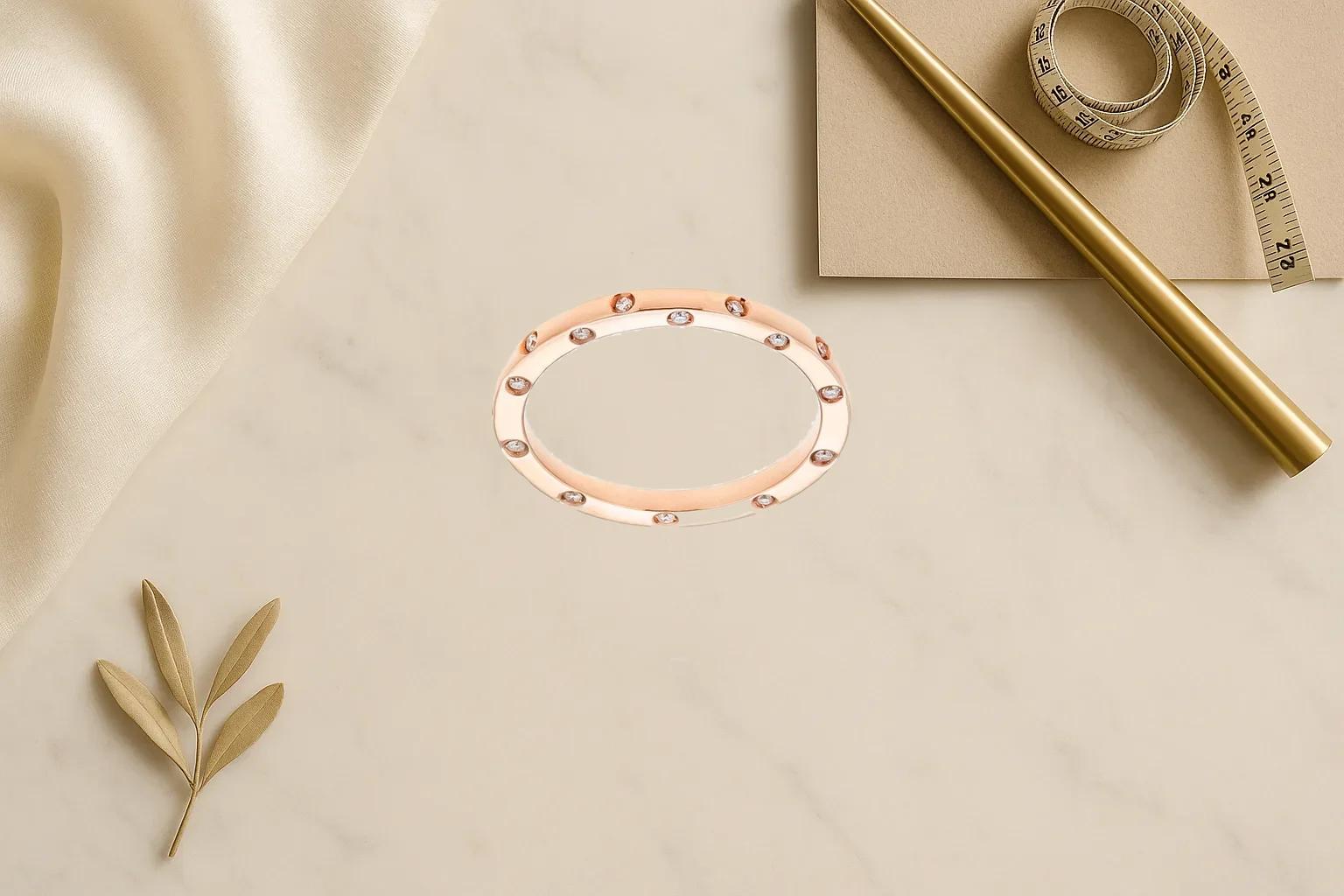
- Not every ring can be resized. A plain band ring resizes easily. An eternity ring set with stones all the way round usually cannot — there is no free metal to work with. The same goes for tension settings and for patterns that run continuously around the shank. When the design cannot be altered, the first measurement has to be right.

When the ring is a surprise
A proposal is the one case where you cannot simply ask. Three approaches actually work, in order of reliability:
- Borrow a ring she wears on that ring finger, for an hour, and measure its inside diameter. It is the only method that gives you a certain number.
- Ask the people around her — mother, sister, closest friend. Far more often than you would expect, somebody already knows.
- Use the statistical middle and plan for a resize. In Europe the most common women's ring-finger sizes cluster between 52 and 54 mm of inside circumference (Italian 12 to 14, roughly US 6 to 6 ¾); men's between 60 and 64 mm. A classic solitaire with a claw setting and a plain shank is straightforward to adjust after the answer is yes.

Right size, right ring
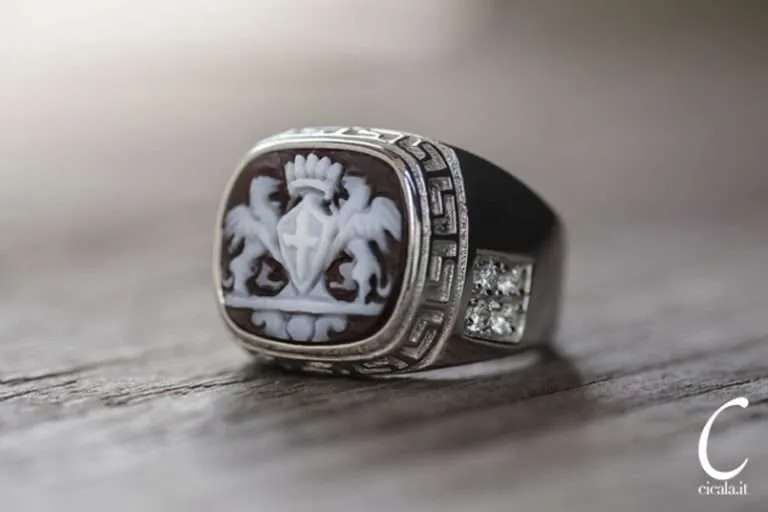
Once you have the number, the interesting part begins. Our rings are organised by how they are built rather than by what they are called: wedding bands for the marriage itself, solitaire rings for a single stone, trilogy rings for three — past, present and future — eternity rings set all the way round, signet rings for the little finger, and plain band rings for every day.
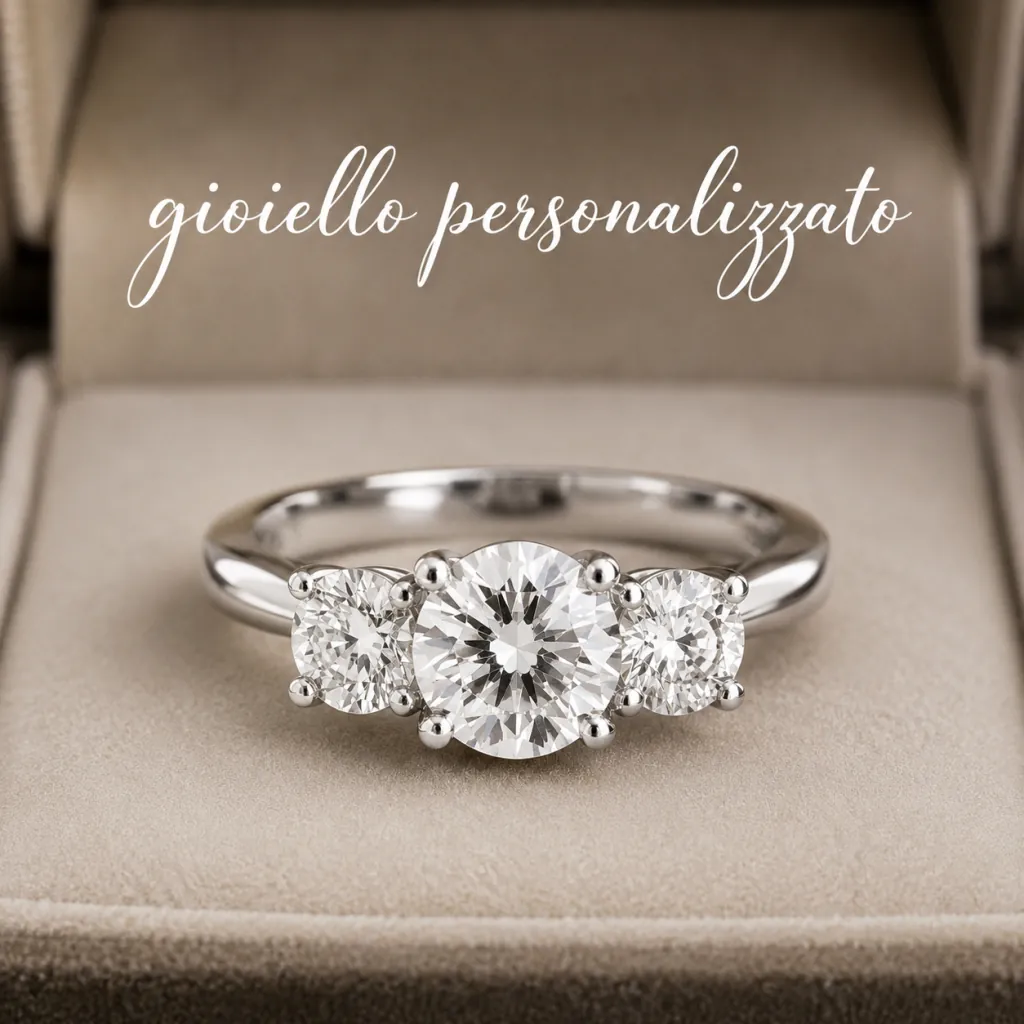
And if you are still unsure after all of this — which happens most often with wedding bands — do not guess. Write to us before you order. The inside diameter of a ring that fits, plus the model you are looking at, is all we need.
Browse all rings → Ask us about sizing →Buying jewellery from an Italian house
Cicala is a family jewellery house in Genoa, on the Italian riviera. We opened in 1950, and we still sell out of a real shop with a goldsmith's bench behind it. If you are reading this from outside Italy, three things are worth knowing before you order.
- Prices convert, and Italian VAT comes off outside the EU. Choose your country in the Ship to selector: the site switches currency, and for deliveries outside the European Union the 22% Italian VAT is removed before you pay.
- Import duty is estimated on the product page, not sprung on you at the door. The courier collects it directly; it never passes through us.
- Every parcel is insured, tracked and unmarked — nothing on the box says what is inside. Costs are on the shipping page, and you have fourteen days to change your mind under our returns policy.
Sizing questions are the ones we answer most often, and we answer them by email in plain language: write to us with what you know — a ring that fits, a chain you already wear, a wrist measurement — and we will tell you what to order. Resizing and chain shortening happen at our own workshop.
Frequently asked questions
How do I find my ring size at home?
Measure the inside diameter of a ring that already fits that finger, using a ruler, and read the size off a conversion table. If you have no ring to copy, wrap a half-centimetre strip of paper around the base of the finger, mark the overlap and measure the length in millimetres: that is the inside circumference.
What does Italian ring size mean?
The Italian size is the inside circumference of the ring in millimetres minus forty. A ring measuring 54 mm inside is an Italian size 14, which is close to a US 6 3/4 and a UK N 1/2. France and Spain generally use the same convention as Italy.
What is the average women's ring size?
Most women's ring fingers fall between 52 and 54 mm of inside circumference — Italian 12 to 14, roughly US 6 to 6 3/4. Men's ring fingers most often fall between 60 and 64 mm.
Can a ring be resized after purchase?
Usually yes, by one or two sizes, as long as part of the shank is free of stones. Eternity rings set all the way round, many tension settings and rings with a pattern running continuously around the band generally cannot be altered. We resize in our own workshop in Genoa.
Should I size up for a wide wedding band?
Often yes. A 6-8 mm band grips more of the finger than a thin one and wears tighter, so half a size more is common. Ask before ordering if you are between sizes.
When is the best time of day to measure a finger?
Around the middle of the day, with hands at normal temperature. Fingers are thinner in the cold and early in the morning and thicker in warm weather or after exercise — the swing can be a full size.
Craft, guides and new arrivals
Subscribe to receive the stories from our magazine, our buying guides and a selection of pieces chosen by our goldsmiths and watchmakers.