Jewellery Guides
Italian Handmade Jewellery: How to Read the Two Stamps
Italian handmade jewellery is a phrase that survives translation badly. It gets printed on things stamped out by the thousand, and it gets left off pieces that really were built on a bench. The good news is that Italy makes the check unusually easy: by law, every precious item carries two marks, and between them they answer the two questions that matter — what the metal is, and who made it.
The two stamps on Italian handmade jewellery, and what they say
The first is the fineness, in thousandths: 750 for 18-carat gold, 925 for sterling silver. The second is the maker's identification mark — a number followed by the two-letter code of the Italian province where the workshop is registered, inside a small shaped outline. That second stamp is the interesting one: it is not decorative and it is not a brand logo, it is a registration, and it means a specific bench in a specific town answers for the piece.
So if you are holding something and wondering: turn the clasp over. A bare 750 with no maker's mark is a piece whose origin nobody has signed for.
Why the gold weighs differently across Europe
This is the part that surprises German, Austrian and British buyers, and it is the strongest argument for buying Italian handmade jewellery at the source. Italy sells gold jewellery almost exclusively at 750 — eighteen carats, seventy-five per cent gold. Germany and Austria sell a great deal of 585 (fourteen carats) and even 333 (eight carats); Britain's default is 375, nine carats. Two chains of the same weight and the same price can therefore be two very different objects: at 375 the majority of what you are holding is not gold at all.
Silver is the one place where Europe agrees: 925 means the same thing everywhere.
Handmade, machine-made, and the honest middle
Most good Italian jewellery is neither purely one nor the other. Chains are usually machine-drawn — nobody hand-forges a snake chain in 2026 — while the setting, the assembly, the soldering and the finishing are bench work. What you should expect from a house that says handmade is variation: two examples of the same reference are cousins, not clones, and stone colour and gold weight shift slightly between them. Perfect uniformity across a hundred pieces is a sign of a press, not of a craftsman.

Three pieces that show what the money buys
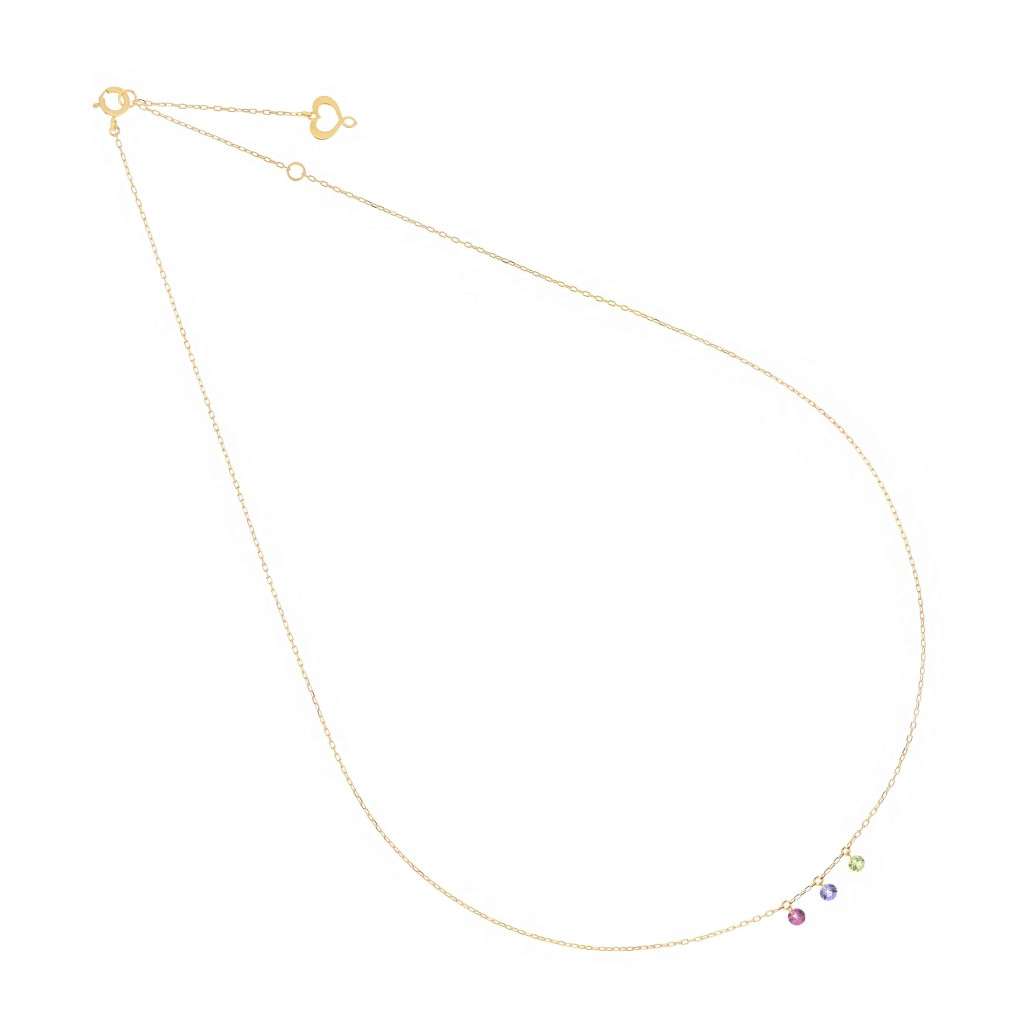
- A 750 gold choker with three stones held by nothing — rhodolite, tanzanite, peridot — at 342 € as we write.
- A single hoop in 925 silver under heavy rose-gold plating, 134 €: the way to buy Italian design when the budget is not gold.
- A koi ring, listed 159 € and 135,15 € today.
Ring sizes: the one thing worth checking twice
Italian sizes count the inner circumference in millimetres and then take forty off it: a finger measuring 52 mm is a French 52 and an Italian 12. Germany, Austria and Switzerland quote the inner diameter instead (16,5 mm is about an Italian 12), and a British N lands around an Italian 13. Our ring size guide has the full conversion table, and if you are between two numbers write to us before ordering: it is a two-minute answer, and it saves a return.
Buying it from Italy, from anywhere in the Union
There is no customs step inside the EU, VAT is settled at checkout against your delivery address, and the parcel travels insured, tracked and anonymously packed — two to seven working days for Europe. Two years of legal warranty of conformity apply wherever you live in the Union, and the maker's warranty card comes in the box. If a ring size is the only uncertainty, the size guide converts between the Italian, French, German and British systems.
Ordering from Italy: what a European buyer actually gets
Cicala Gioiellerie is a jeweller in Genoa, on the Italian riviera. We opened in 1950, we still sell out of a real boutique with a goldsmith's bench behind it, and sending a parcel to Paris, Munich, Vienna or Rotterdam is ordinary Tuesday work. Inside the European Union the mechanics are simpler than most people expect.
- No customs, no clearance fee, no paperwork. Italy and the rest of the Union are one customs territory: the parcel travels as if it came from a shop in your own city.
- VAT is already in the price and is calculated at checkout against the delivery address. Nothing is added at the door, and nothing is hidden before it.
- Insured, tracked, and packed anonymously. Nothing printed on the box says what is inside. The exact delivery cost appears before you pay — see shipping and costs — and Europe is quoted at two to seven working days.
- Two years of legal warranty of conformity, valid across the Union wherever you live, on top of the maker's own warranty card that travels in the box: warranty page.
- Fourteen days to change your mind under the returns policy, with card, PayPal, Apple Pay, Google Pay or bank transfer at checkout.
- A workshop, not a warehouse. What we sell we also repair, in our own workshop — and we answer e-mail in English.
See our Italian jewellery from Maman et Sophie →
Frequently asked questions
How can I tell if Italian handmade jewellery is really gold?
Look for two stamps: the fineness in thousandths — 750 for 18-carat gold, 925 for sterling silver — and the maker's identification mark, a number plus the two-letter code of the Italian province where the workshop is registered.
Is Italian gold different from German or British gold?
The alloy standard differs by market. Italy works almost entirely in 750, eighteen carats; Germany and Austria sell a lot of 585 and 333; the British default is 375, nine carats.
Does handmade mean no machinery at all?
No. Chains are normally machine-drawn, while setting, assembly, soldering and finishing are bench work. The tell is slight variation between two examples of the same reference.
Is 925 silver the same everywhere in Europe?
Yes. 925 is sterling silver and means the same alloy in every European market, which is why silver pieces travel across borders without confusion.
What happens with customs when it ships from Italy?
Nothing, inside the European Union: no duty and no clearance fee. VAT is calculated at checkout and delivery runs two to seven working days.
Craft, guides and new arrivals
Subscribe to receive the stories from our magazine, our buying guides and a selection of pieces chosen by our goldsmiths and watchmakers.